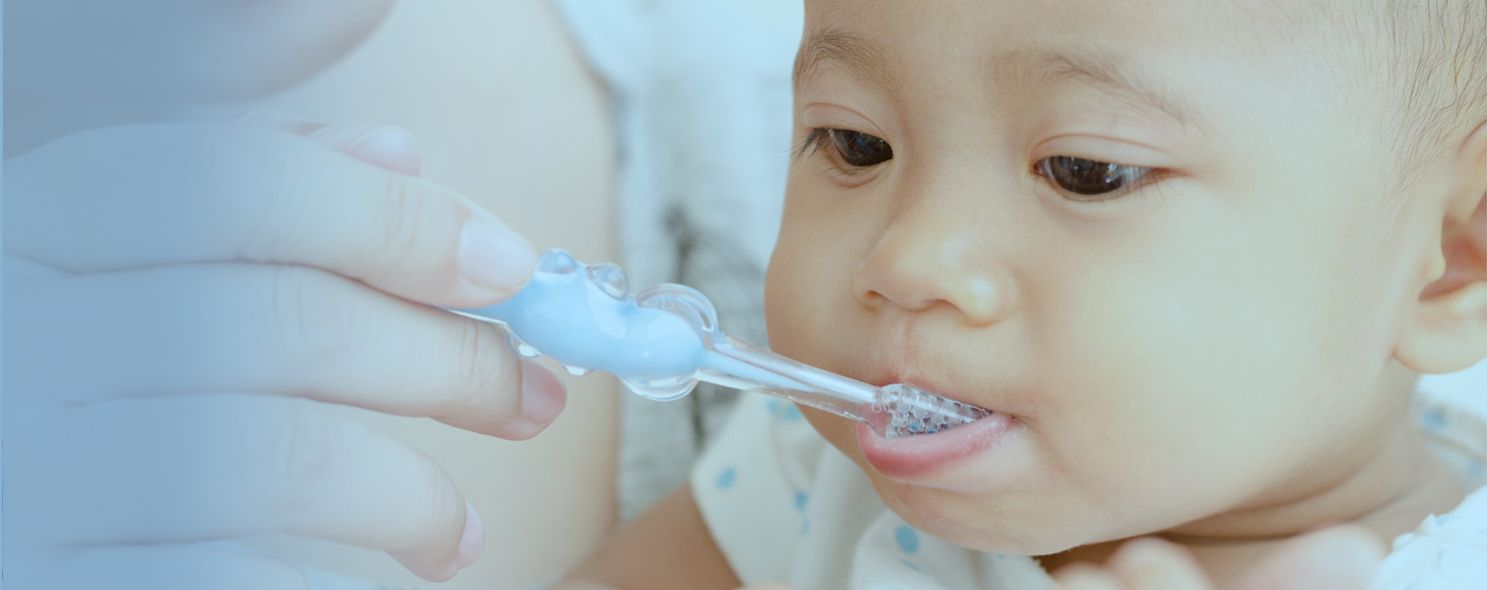
Prioritizing your baby’s dental health shouldn’t start when they get their first tooth. It begins right after birth. Learn how to care for your child’s teeth at every age with the guidance below.
Caring for Baby’s Teeth During the First Year
When feeding an infant from a bottle, it’s important to remember the following:
- Caregivers should avoid testing the bottle’s temperature by mouth.
- If you access well water for your home, use fluoridated water to prepare your baby’s formula. Fluoridated water can be purchased at most grocery stores.
Additionally, don’t practice sharing utensils, drinks, or using caregiver’s saliva to clean pacifiers. If the person caring for baby has high amounts of cavity-causing bacteria in their mouth, it can be transmitted to baby through saliva.
Before teeth begin breaking through, a baby’s gums should be wiped with a soft, clean cloth after feedings to remove the bacteria and sugars from milk.

If your baby has discomfort from teething, rub their gums with a cool, damp or chilled cloth. They can also be given a teething ring.
After the first tooth erupts, it’s recommended to begin brushing twice a day with a soft toothbrush made specifically for infants, a little bit of water, and infant toothpaste that is fluoride-free. Toothpaste with fluoride can be used once the child can spit it out.
While babies develop differently, you can expect the first teeth to erupt between 5 - 7 months. See the chart as a reference for when to expect your child’s teeth to erupt.
At 12 months of age, your baby should:
- Begin using a sippy cup with water only
- Have their first dentist visit
- Wean from pacifiers and thumb sucking
Dental Care for Toddlers through Age Five
General care for a toddler’s dental health should look very similar:
- Brush teeth twice per day and floss once
- Attend dentist visits every six months
Caregivers should continue to brush and floss their child’s teeth until eight years of age. Around five years old, have your child brush first to help them learn the process. Then, caregivers should repeat to ensure the teeth are fully clean.
If a child can cut a piece of meat with a fork and knife or tie their own shoes, they have the hand dexterity to brush alone.

Preventative Dental Care: Sealants

Dental sealants are thin, plastic coatings applied to the chewing surfaces of molars and premolars to prevent tooth decay. They fill in the pits and fissures, creating a smooth surface that is easy to clean, and are mainly used in children at higher risk for cavities.
Generally, dentists can place sealants on children aged 5 – 21. Since they can break or chip over time, touch ups are recommended. They can be placed on 6-year-old molars, 12-year-old molars, as well as the first and second premolars.
Sealants prevent 80% of cavities.
Oral Health Issues
A cavity or tooth decay is a damaged area in the hard surface (enamel) of the tooth that develops into tiny openings or holes. These are caused by a combination of bacteria, frequent snacking, sipping on sugary drinks, and not properly brushing or flossing.
If drinking anything other than water, drink those beverages for breakfast, lunch, and dinner, and drink water only between meals. This is recommended because sipping acidic or sugary drinks such as soda, juice, or flavored water between meals keeps acid levels high in your mouth, leading to enamel erosion and an increased risk of cavities. However, during meals, your mouth produces more saliva to help neutralize acid.
Gum disease occurs in stages. The first stage is gingivitis, which is caused by plaque buildup. Gingivitis can be identified by red, swollen, bleeding gums, and it is reversed by properly brushing and flossing.
If gingivitis is not reversed and continues to progress, it leads to periodontitis. Periodontitis is not reversible, and it causes the bone which supports the teeth to break down. This bone loss can result in tooth loss, in addition to swollen and bleeding gums. Healthy gums do not bleed when brushed or flossed.
All children attending Knox County Schools are eligible to come to Knox County Health Department’s Dental Clinic if they are experiencing a dental emergency or dental pain, regardless of socioeconomic status or insurance coverage. Call 865-215-5110 for more information and to schedule an appointment.