
in play to help them thrive.
Play is not only important for children—it’s their job and its serious business.
Play is how they learn and communicate, it helps them cope with unfamiliar settings and can overall help them make sense of this mighty big world. Encouraging play throughout each developmental stage can help them meet their milestones with ease so don’t underestimate its power!
Besides, who doesn’t want to be a kid and play all day? Now you have the perfect excuse to engage in a little silliness and reap the benefits as well. Being active physically and mentally through play can also help you stay strong and healthy. And, when kids see you having fun, they are more likely to join in and engage in play for longer periods of time. So, throw shame to the wind and quack, bark, meow, and moo till the cows come home.
“Play is often talked about as if it were a relief from serious learning. But for children, play IS serious learning. Play is really the work of childhood.”
-Fred Rogers
Do I need fancy toys to make my baby smarter?
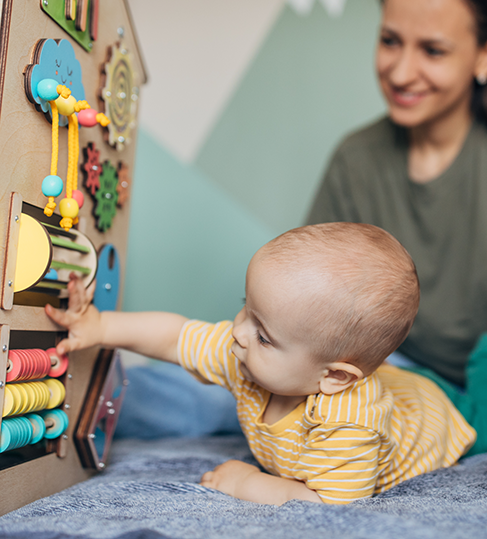
Proceed with caution. The research doesn’t support it. Safe household items can be great learning tools. Plastic bowls are good for filling and dumping. Pillows work well for climbing and making caves. Remember, the more your child has to use their mind and body to problem solve and develop their own ideas, the more they learn.
The best educational toys encourage caregiver–child interaction through play.
Use caution when you see "educational" on the label. The truth is most tablets, computer games, and apps advertised as "educational" really aren't. Most "educational" apps target memory skills, such as ABCs and shapes. These skills are only one part of school readiness.
The skills young children really need to learn for success in school (and life) include impulse control, managing emotions, and creative, flexible thinking. These are best learned through unstructured and social play with family and friends.
Research suggests tablet-based toys may actually delay social development for infants and young children, because they don't include real-life facial expressions, gestures, and vocalizations.

Screen time and your little one...
Is screen time okay for babies under 2?
The American Academy of Pediatrics recommends very limited screen time (if at all!) for children under 2. However, as it is hard to escape technology these days, if introducing any digital device be sure to engage with prompting language: who is on the screen, repeat what the person on the screen says or describe what is happening by pointing out colors, shapes, animals, etc.
Make screen time social and meaningful.
Using a screen to facetime friends and family is a great option to make screen time a quality, social interaction as opposed to passive content to view.
Limiting screen time to certain activities or times of day can also help set healthy boundaries around its use. And, like with anything else, modeling healthy behaviors is the number one way children are going to learn what to do.