
A baby requires sleep. Lots of it. It’s typical for an infant to sleep up to 16-17 hours per day! How babies sleep is just as important as the amount of sleep they get.
Our region sees an alarming number of accidental infant deaths, most of which are related to unsafe sleep practices. These are tragedies that can be largely prevented through awareness, practicing safe sleep recommendations, and spending a little time to make sure your crib is safe, for example:
- If your baby sleeps in a crib and you can fit a can of soda between the slats of that crib, that means a child’s head, hand or foot could get stuck.
- Make sure the mattress is firm and fits snugly; otherwise a child could get stuck between the gaps. Cover it with a crib sheet with nothing else in it.
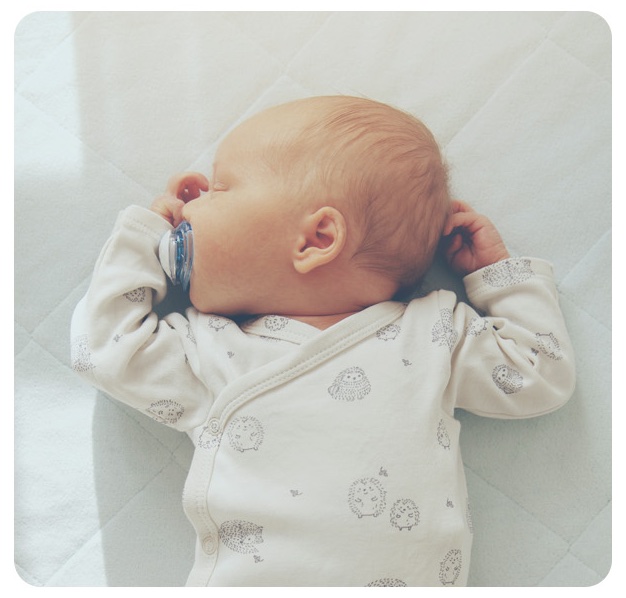
Rid unnecessary risks from their sleep space.
A safe sleep environment for naps and at night can help reduce the risks of SIDS and other sleep-related causes of infant death, such as suffocation. KCHD encourages caregivers to follow the safe sleep recommendations from the American Academy of Pediatrics (AAP).
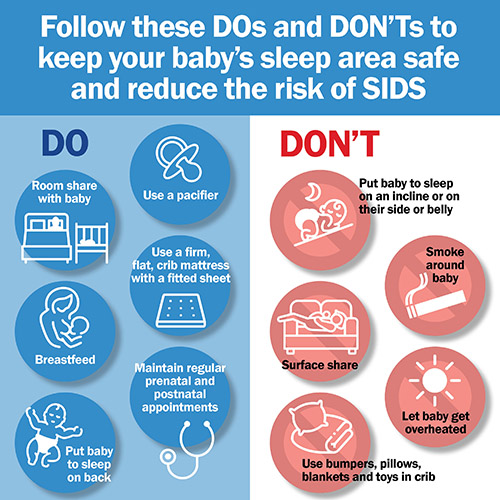
- Share a room with baby for at least the first 6 months, with baby in their own sleep space (crib, bassinet, or portable pack and play), separate from your bed.
Babies with their own sleep area are at lower risk for injury and death from situations like an adult accidentally rolling over them. Having baby’s sleep space near, but not in your bed is safer than sharing bed with baby. It is also safer than putting baby in their own room. - Place all babies—including those born preterm and those with reflux—on their backs for all sleep times (naps and at night) until they are one year old.
Lying on the back helps your baby to easily draw in air by keeping the mouth and nose free of obstructions. An infant sleeping on its side or stomach increases the risk of SIDs. - Use a sleep surface for baby that is firm and flat, level (not at an angle or inclined), and covered only with a fitted sheet in a safety-approved crib, bassinet, or portable crib.
Soft surfaces, like couches, memory foam or air mattresses, armchairs, and thick blankets or quilts are not safe places for babies to sleep. Sitting devices, such as swings or car seats, and inclined or tilted sleep surfaces, with one end higher than the other, are also not safe sleep places for babies. - Keep things out of baby’s sleep area—no objects, toys, or loose items.
While we know that stuffed animals, bumpers, and all the cute accessories make baby’s crib seem so inviting and cozy, they often do more harm than good. Research links crib bumpers and soft, thick bedding to serious injuries and deaths from suffocation, entrapment, strangulation and SIDS. Remove everything from baby’s sleep area, especially if they are:- Soft or squishy (pillows, stuffed animals, and crib bumpers)
- Plush or thick (comforters and blankets)
- Loose (non-fitted sheets and blankets)
- Weighted (weighted blankets, weighted swaddles, weighted objects)
sleep
can be
super....
If you’re worried about keeping your baby warm throughout the cold winter nights, try putting them to sleep in a wearable blanket or sleep sack. This will keep them warm and safe for a great night’s rest.
An easy way to remember the most important factors to safe sleep is by knowing your A,B,C’s.
- A- Alone
- B- Back
- C- Crib
If you’re ever unsure whether a product is safe for your baby, make sure to check the U.S. Consumer Product Safety Commission for warnings, recalls, and more education. Their website also lists important product updates, news releases, and research. There is even an app for public use! The website can be found here: CPSC.gov
Try Dr. Harvey Karp’s “five S’s” method to help calm your baby to sleep. If you’re a sleep-deprived new parent and your baby is fussy or refusing to sleep, try these tips:
- Swaddle- While there is no evidence to support swaddling as a strategy to reduce the risk of SIDS, some babies prefer it for the warmth and comfort it provides. A few things to keep in mind when it comes to using swaddles- only use one think blanket to swaddle your baby, discontinue swaddling as soon as the baby can break free from it, use a swaddle sack if you don’t feel comfortable with your swaddling abilities, and never use weighted swaddle clothing or blankets on your baby.
- Side or stomach position- NOT to sleep, only while holding. This may help with digestion while also simulating a womb-like sensation. Try gentle rocking or swaying while holding a fussy baby on their side or stomach to help calm them. Once asleep, lay them on their back in their safe sleep surface.
- Shushing- This noise imitates the sounds in the womb, making your baby feel calm and safe. It works best when done loudly. Babies don’t need complete silence to sleep- in fact, this may make them fussier!
- Swinging- Similarly to swaddling and shushing, gentle swinging in your arms or infant swing (while attended) can help to soothe your baby. Be sure to support the head, neck, and body. If using an infant swing, don’t leave them unattended or put blankets or pillows in the swing with them. Once asleep, lay them on their back in their safe sleep surface.
- Sucking- Studies show that pacifiers may reduce the risk of SIDS by between 50-90%, even if the pacifier falls out of baby’s mouth. The National Institutes of Health suggest that pacifier use during sleep may improve autonomic control of breathing and/or airway openness. In premature infants, it might also help develop their sucking reflex and provide the effect of pain relief during minor invasive procedures.
Other important notes about pacifiers: If your baby is breastfed, you may choose to wait 3-4 weeks after birth before offering a pacifier to reduce the chance of any difficulties with latching. Additionally, pacifier use beyond 12 months of age can lead to an increased risk of inner ear infections and beyond 18 months can have a negative impact of dental and speech development. Finally, if a pacifier is used, it’s highly recommended that it is one piece so there is no choking hazard if something were to break. It’s also advised to never attach clothing or toys to the pacifiers, especially during sleep, and they should be regularly cleaned and sterilized (you can do this by boiling in water for 15 minutes or spraying with an anti-microbial agent).
When you have no other options: Alternative sleep surfaces are only considered a safe option if they comply with the June 2021 CPSC rule that all infant sleep products meet existing federal safety standards for cribs, bassinets, portable cribs or play yards. This includes inclined sleep products, hammocks, baby boxes, in-bed sleepers, baby nests and pods, compact bassinets, travel bassinets and baby tents. If a product doesn't meet federal safety standards, avoid it. That being said, the AAP also says that in an emergency, you can temporarily put your baby to sleep in a basket, dresser drawer, or something similar. It should have thin, firm padding. As soon as you can get a CPSC-approved sleep surface, move your baby to that instead.
- Moses baskets are not properly regulated by the CPSC. Even though some may be considered as bassinets, some others are unstable, have small parts or are structurally insufficient to hold an infant safely. There have also been a few recalls in the past. Choose a recommended bassinet instead.
- Sitting devices, such as car seats, strollers, swings, infant carriers, and infant slings, are not recommended for routine sleep in the hospital or at home, particularly for infants younger than 4 months. It is easy for a baby’s airway to become restricted, limiting oxygen flow.
- The safest way for an infant to sleep is alone, on their back and in a crib. However, there are ways to decrease the risks of co-sleeping by placing a mattress on the floor, making sure the adults in the bed are sober and not on medications that may decrease awareness, tie up long hair, and not using covers or blankets. Parents considering co-sleeping should discuss the choice with their doctor and do their research.
- If you or someone you know is unable to afford an approved safe sleep surface for an infant under 12 months old, please reach out to Knox County Health Department’s Cribs for Kids program at 865-215-5170 or the Community Health Access & Navigation in Tennessee (CHANT) program at 865-215-5190.
Give your baby the nutrients they need.
Breastfeeding provides your baby with essential nutrients and antibodies to support their growth and immune system. We offer guidance on techniques, positioning, and common challenges to help you and your baby enjoy the breastfeeding experience.
Help your baby become immune to illnesses.
Every baby deserves a strong foundation for lifelong wellness. Through the Mighty Moments program, we help protect babies from serious illnesses like measels, whooping cough, and the flu by keeping parents and community members on track with recommended immunizations.
Interested in learning more? Explore the resources below for more information on infant safe sleep!