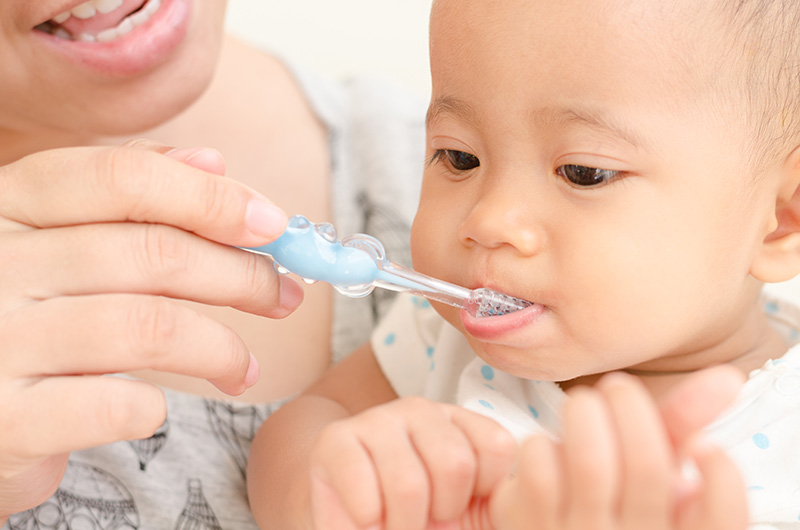

Get guidance during your breastfeeding journey.
Deciding to Breastfeed is a personal choice for each mother. This decision often depends on a variety of factors specific to each family’s situation. Regardless, each mother who decides to try breastfeeding, should be armed with the education to make an informed choice. Make sure you’re setting realistic expectations for yourself with breastfeeding. Breastfeeding can be hard, which is why it is important to have a support system.
Health benefits for baby: Breastfeeding gives your baby a healthy start that follows them throughout life. Each baby has different needs, and a mother’s body produces the cells, hormones, and antibodies in breastmilk that helps provide their baby a unique protection that’s perfect for them and their changing needs! Research has shown that breastfed babies have lower risks of:
- Asthma
- Leukemia during childhood
- Childhood obesity
- Ear infections
- Eczema
- Diarrhea and vomiting
- Lower respiratory infections
- Necrotizing enterocolitis, a disease that affects gastrointestinal tract in premature babies (babies born before 37 weeks gestation).
- Sudden infant death syndrome (SIDS)
- Type 2 diabetes
your
nursing
goals....
Health benefits for mom: Some women who breastfeed report returning to their pre-pregnancy weight quickly. It’s a common belief that breastfeeding may help with weight loss after pregnancy, but this hasn’t been proven yet. However, breastfeeding has been linked to a lowered risk of some health problems for mom:
- Postpartum depression
- Cardiovascular disease
- Type 2 diabetes
- Certain breast cancers
- Ovarian cancer
How breastmilk changes: Your breastmilk changes composition over time to match your baby’s needs.
- Colostrum is the first milk a woman produces. This has been nicknamed “liquid gold” because of its deep yellow color. Colostrum is a thick milk made during pregnancy and just after birth that’s packed full of vitamins, nutrients, proteins, and antibodies that protect your baby from infections. Even though your baby drinks only a small amount of colostrum at each feeding due to their tiny stomachs, this milk helps a newborn’s digestive system grow and function.
- Between days 5-14, you may notice a creamier, whiter colored milk than the colostrum you’re used to. This ‘transitional milk’ contains higher amounts of fats, calories, and lactose.
- From week 4 and on, milk becomes fully mature. This means it carries even higher levels of minerals, enzymes, hormones, fat, water, sugar, and proteins to help your baby continue growing. What’s really amazing is that breastmilk changes composition as your baby’s needs change!
- Eating different foods and spices can cause a woman’s breastmilk to vary in smell, taste, and color. Exercising can even change the milk’s taste due to the production of lactic acid.
Breastfeeding Concerns: Many mothers often wonder if a certain position is better than another or if their baby is latched correctly. Here are some things to look out for to ensure your baby has a good latch, and therefore, eating enough.
- Your baby’s lips might flange out, making a “fishy face”
- Baby’s chin is touching the breast
- No clicking sounds during feeding
- Baby’s cheeks stay round and don’t dimple
- Baby’s ears may move a little bit during feeding, just like adults do sometimes when chewing
- All or most of the areola is in baby’s mouth
- On the other hand, if you notice any of these things happening, you may want to spend a little more time working on the latch. You can also seek help from a lactation consultant or someone with experience whom you trust.
- You feel sharp pain or pinching during feeds
- Notice creasing, soreness, blistering, or flattened nipples after feeds
- Clicking or sucking sounds during the feed
- Baby shows inconsistent sucking
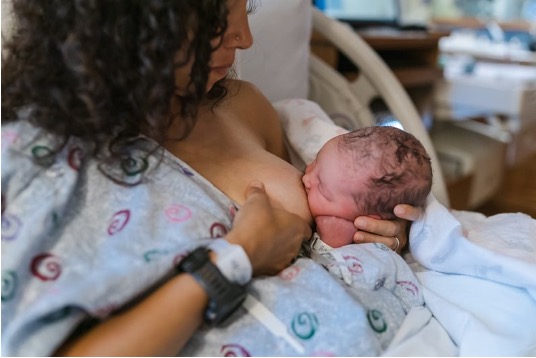
The Football Hold
- Place the baby on his/her back laying next to you on the side you will be feeding
- Use pillows to prop up your arm and support the baby
- The baby's legs should be at your side under your arm
- Use your palm to support the upper back while placing your thumb by one ear and index finger by the other ear, with the arm that is holding the baby
- Support your breast with the free arm
- Bring the baby to your breast, not your breast towards the baby

The Cradle Hold
- Cradle your baby on the side you will be feeding on
- Your baby's head should be resting on the bend of your arm and baby's body should be on your arm
- The baby should be on his/her side, facing toward the breast
- Use pillows to support the arm holding baby

The Cross Cradle Hold
- Place a pillow on your lap to support the baby and your arm
- Use the arm opposite from the breast you will be feeding with to support the baby
- Use your palm to support the upper back while placing your thumb by one ear and index finger by the other ear
- Use the arm on the side you will be feeding on, to support your breast (create a breast sandwich)

Side-Lying
- Lie on your side with pillows to support your back and head
- Face your baby toward your breast, supporting the baby with one hand
- With the other hand, grasp your breast and touch your nipple to your baby's lips
- Once your baby latches on, use one arm to support your own head and the other to help support the baby and bring the baby close
To breastfeed using the other breast, you can lift your baby up using a pillow. Or you can turn on your other side and position the baby on this side as you did for the first breast.
Note: A side-lying position might be a good choice when you're resting, although it's important to return the baby to the baby's own bed to sleep.
This position can make it hard to see how well your baby is latched, so it may be best to try this position once both you and your baby are used to breastfeeding.
How to tell if a breastfeeding session is successful or needs more attention
Many mothers often wonder if their baby is eating enough or getting enough during feeds. This is a common concern since we can’t measure how much milk baby is ingesting if it’s not in a bottle. Here are some things to look out for:
Signs of a Poor Feed
- Inadequate number of stools and wet diapers
- Inconsistent and/or weak sucking
- Baby not satisfied after feeds
- Rapid and/or excessive weight loss
- Engorgement or nipple trauma
Signs of a Good Feed
- Adequate number of stools and wet diapers
- Breasts feel softer after a feed
- Consistent sucking and you can hear baby swallowing during feeds
- Seeing milk in baby's mouth
- Small amount of weight loss in the first few days
You might be wondering, “what’s an ‘adequate’ amount of dirty diapers??” The first few days after birth, they may only wet one or two diapers each day. After that, they should need five or six disposable (or six to eight cloth) diaper changes every 24 hours, plus have two to five poopy ones each day.
Minimum number of wet diapers and poops by days 1-7
Age of Baby | Minimum # of Wet Diapers | Minimum # of Poops |
|---|---|---|
Day 1 | 1 | 1 |
Day 2 | 2 | 3 |
Day 3 | 5 | 3 |
Day 4 | 6 | 3 |
Day 5 – Day 7 | 6 | 3 |
For more information and resources, including the 9th Edition of KCHD’s Community Breastfeeding Guide, educational modules, and peer support, visit https://knoxcounty.org/health/breastfeeding.php.
Promote safer sleep for your baby.
Anyone can be a hero for infants and babies by learning and implementing practices for safe sleep, such as placing them on their backs, using a firm mattress, and keeping the crib free of toys or loose bedding. With essential resources and tips like these, the Mighty Moments program helps protect babies from danger during sleep.
Help your baby become immune to llnesses.
Vaccinations are an important step in keeping your baby healthy. Through the Mighty Moments program, we help protect babies from serious illnesses like measles, whooping cough, and the flu by keeping parents and community members on track with recommended immunizations. Because every baby deserves a strong foundation for lifelong wellness.